
Izard County Sex Offender Checks
An Izard County sex offender lookup begins with the Arkansas Sex Offender Notification System, which ACIC manages within the Arkansas Department of Public Safety. Filter the state system by Izard County, city, ZIP code, address, place, or name. The Izard County Sheriff also publishes local notice information, but its own disclaimer says that list is incomplete and excludes Level 1 registrants. Use the state registry as the main county search, then use the sheriff notice to understand local publication and contact practices.
A registry match is a safety resource, not a new finding of guilt. Confirm the name, aliases, photo, physical details, mapped location, offense information, and risk level before drawing a conclusion. The broader Izard County criminal history overview explains why registry, court, jail, and repository records answer different questions.
Why the Izard County List Is Incomplete
The sheriff releases local information under Arkansas community-notification law, including Act 989 of 1997, but expressly states that its page is not a complete list of all people required to register with the office. Level 1 offenders do not appear in that local notification. A blank local result therefore does not establish that no registration exists.
Risk levels describe assessed potential to reoffend. Arkansas uses Level 1 for low risk, Level 2 for moderate risk, Level 3 for high risk, and Level 4 for a sexually violent predator. Someone who refuses or fails to complete assessment is assigned Level 3 by default. Those rules explain why the state search and local notice can show different scopes.
Arkansas Sex Offender Registry Searches
The free state portal is the most direct official channel for an Izard County registry check. Search broadly first, then narrow only when the results require it.
- Open the Arkansas Sex Offender Notification System and review its use terms.
- Choose Izard County or enter a name, address, city, ZIP code, or place.
- Compare the result list and map with the identifiers you already know.
- Open the profile and read its offense, level, address, and status fields together.
| Search field | Type | Required | Use |
|---|---|---|---|
| Name | Text | No | Find a known person |
| Address | Text/map | No | View address proximity |
| City or ZIP | Text/select | No | Narrow a community |
| County | Select | No | Choose Izard |
| Place | Text | No | Search a named place |
| Map/List | Control | No | Change the result view |
Izard County and the National Search
County borders do not limit a person’s prior addresses or registration history. The National Sex Offender Public Website searches participating state, territorial, and tribal registries. Its name search uses first and last name, while its location search can take up to five ZIP codes. County and city fields can widen the check beyond Izard County.
The official NSOPW search shown below is useful when the Arkansas result suggests an out-of-state connection. It does not replace the Arkansas profile for current Izard County publication details.
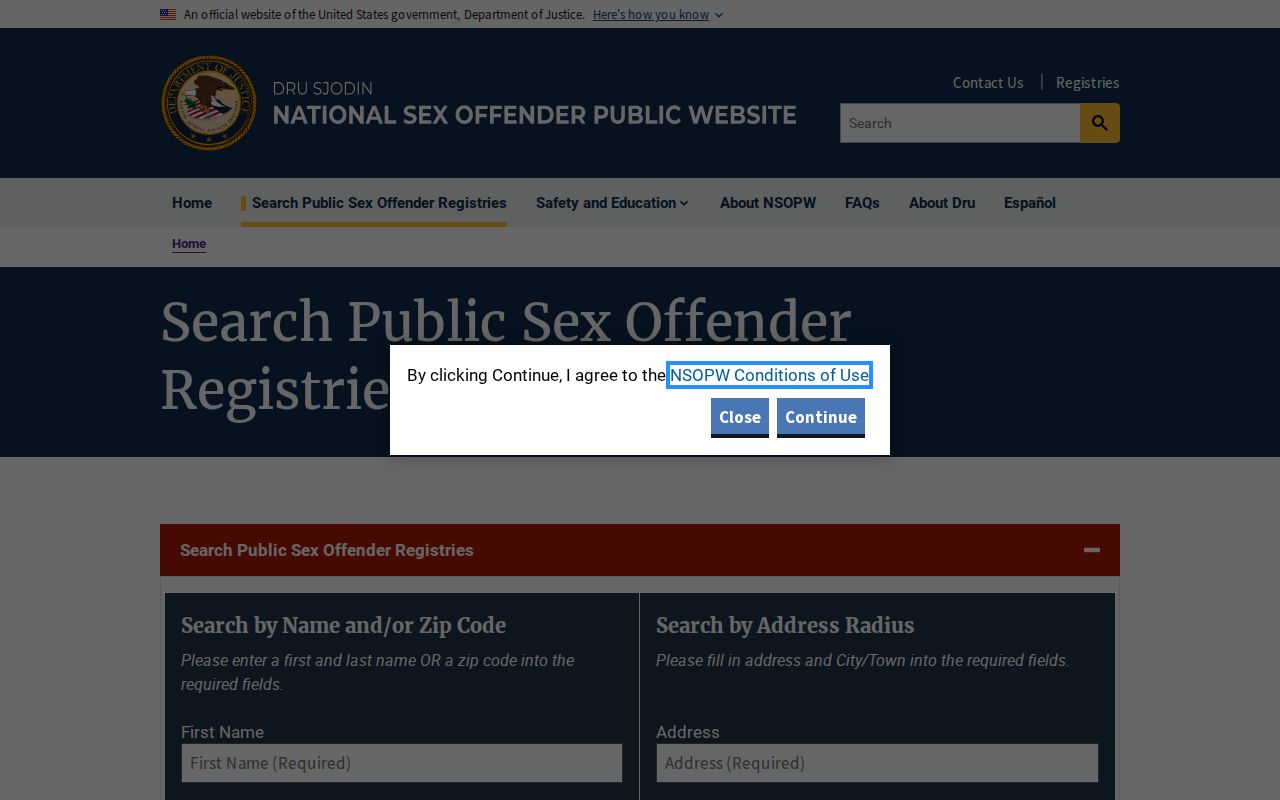
Read a national match through the source jurisdiction’s profile because each jurisdiction controls its own published fields and updates.
Izard County Registry Profiles: What They Show
A public profile combines identity, location, assessment, and offense data. Treat all fields as a single record and report a suspected error to the listed law-enforcement contact.
| Name and aliases | Published identity names used for matching. |
|---|---|
| Photo and description | Photo, physical description, marks, or tattoos when supplied. |
| Registered location | Address or mapped location available for public notice. |
| Offense information | Conviction or qualifying-offense details shown by the registry. |
| Risk level | Arkansas assessment level from 1 through 4. |
| Status | Registration or compliance information and agency contact channels. |
| Other identifiers | Vehicle details and other published identifiers when provided. |
Assessment Changes Izard County Visibility
Level 1 means low risk, yet Izard County’s local notification page omits that level. Levels 2 through 4 have broader public-notice implications. A default Level 3 can reflect failure to submit to assessment, so the number does not by itself describe every fact in the underlying court record.
For a deeper case history, use the official Izard County Court Case Lookup. Court charges, pleas, dispositions, and sentences belong to the case file, while the registry focuses on current registration and notice.
Registration Levels and Duties in Arkansas
Arkansas level and registration duration are related but not identical. Ark. Code Ann. 12-12-919 identifies lifetime categories, including aggravated sex offenses, Level 4 sexually dangerous persons, repeat sex offenses, and other statutory cases.
| Level or status | Meaning | Visibility or duration |
|---|---|---|
| Level 1 | Low risk | Not included in the Izard sheriff local notice |
| Level 2 | Moderate risk | Publishable offenders generally receive public notice |
| Level 3 | High risk | Public notice; also default when assessment is not completed |
| Level 4 | Sexually violent predator | Lifetime registration can apply |
| Lifetime category | Statutory offense or repeat status | Governed by Ark. Code Ann. 12-12-919 |
Izard County Sheriff Registration Questions
The Izard County Sheriff’s Office is at 300 Circle Drive in Melbourne and can be reached at 870-368-4203. Use the office for local registration questions or to report a possible compliance issue. Its online contact form is not monitored around the clock and warns against sending confidential or sensitive information by email.
The sheriff also cautions that it lacks general legal authority to decide where a registrant lives unless a court restriction applies. That distinction matters: the registry reports information and supports lawful notice, while residence limits depend on governing law and case-specific court orders.
When an Izard County Match Looks Wrong
Start by comparing aliases, photo, physical description, offense details, risk level, and mapped location. Similar names alone are weak proof. If a location or status seems stale, use the agency contact attached to the official profile instead of repeating the claim elsewhere.
The local sheriff page says listed addresses are locations reported by offenders. That phrasing is an important limit. Verification belongs with law enforcement, and a user should not visit an address or confront a person to test registry data.
Using Izard County Registry Information Lawfully
Community notification exists for awareness and practical safety planning. It is not permission to punish, threaten, shame, or organize contact with a registrant or household.
Lawful-use warning: The Izard County Sheriff states that registry information must not be used to threaten, intimidate, or harass a registered offender. Citizen abuse will not be tolerated. Arkansas registration duties, including lifetime categories, are addressed in Ark. Code Ann. 12-12-919.
Use a confirmed profile to make calm safety choices, share accurate official links when needed, and contact the sheriff about a genuine compliance concern. Do not treat a map marker as an invitation to investigate on your own.
Planning an Izard County Address Search
An address-based check should start with the state portal’s address or map control, then expand to city, ZIP code, place, and county if the first view is too narrow. Izard County includes small cities and rural areas where a mailing city may not describe the exact jurisdiction. A county filter helps catch published locations outside a named city, while the map helps a reader understand proximity without guessing from a street name.
Write down the address used, the date of the search, and whether the result came from map or list view. Registry data can change as people report moves or an agency updates status. Saving the search method makes a later comparison more useful than relying on memory. If a marker appears close to a place of concern, open the profile and confirm the person, offense information, status, and registered location. Do not infer identity from a map point alone.
Matching Names in the Izard County Registry
Name searches can produce more than one person or no result after a small spelling difference. Compare aliases, photo, physical description, and location. The state portal supports name searches, while NSOPW requires first and last name for its name mode. A ZIP search offers a second national route when the correct spelling is uncertain.
Risk level is not an identity field. Neither is a city name. A strong match uses several details from the official profile. When the record belongs to another state, follow the national result back to that jurisdiction’s source page. NSOPW brings jurisdictions together, but the source agency controls the underlying data and any correction process.
Izard County Community Notification Scope
The sheriff’s local page says it publishes information for community notification and that listed people reported living at the shown locations. It also explains that the sheriff has no general legal power to direct where an offender lives unless a court restriction exists. These statements limit what a public user should conclude from the page.
Local publication does not replace the state registry, and an omitted Level 1 entry does not mean the person has no registration duty. Likewise, a listed address is not a warrant to contact an occupant. The sound response to a suspected reporting problem is to give the official profile and factual concern to the sheriff. Law enforcement, not a private searcher, determines compliance and investigates an alleged failure to register.
Registry, Court, and ARCH Results Differ
The Arkansas registry reports registration and notification facts. Search ARCourts reports public case information. ARCH is a paid name-based repository product that can report Arkansas convictions, certain open felony arrests under three years old, and whether a subject is registered or required to register. These channels overlap, but none is a full substitute for the others.
ARCH omits juvenile records, dismissed and not-guilty charges, unresolved misdemeanor arrests, older open felony arrests, warrants, sealed records, pardoned convictions, federal matters, and out-of-state records. Its name and birth-date matching is not fingerprint verification. A user who needs to understand the qualifying case should read the public court disposition; a user checking current publication should rely on the registry profile.